
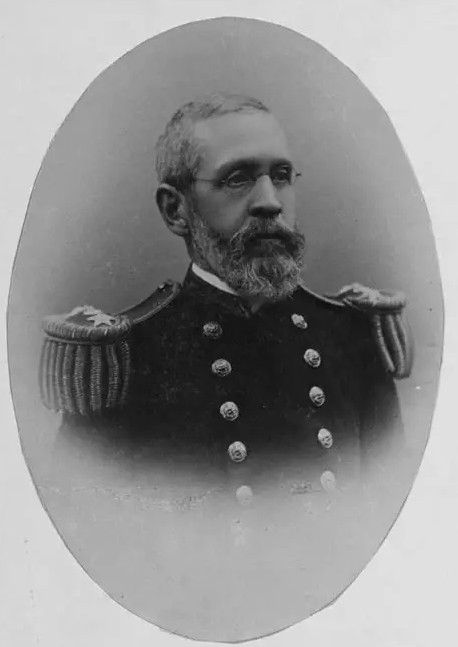
 Rear Admiral James Augustin Greer (1833–1904)
A Distinguished Officer of the United States Navy Through War, Exploration, and Global Service
The MacGregor Connection:
Greer is a well-accepted and recognized Sept of Gregor
Early Life & Naval Beginnings (1833–1855)
Rear Admiral James Augustin Greer was born on February 28, 1833, in Cincinnati, Ohio. Raised in a family that valued discipline, education, and public service, Greer grew up in an environment that naturally pointed him toward a life of structure and responsibility. His family later moved to Dayton, where his father operated a manufacturing business — a setting that surrounded young James with the industrious spirit of early American growth.
Greer began his naval career astonishingly early. On January 10, 1848, just shy of his 15th birthday, he enlisted in the United States Navy as an acting midshipman. His first assignment aboard the sloop USS Saratoga offered him a strong introduction to naval life, exposing him to the demanding routines, discipline, and expectations of an officer in the making.
In 1853, he entered the United States Naval Academy. Only a year later, he graduated as a passed midshipman, demonstrating exceptional promise. Greer’s early assignments included service in the Paraguay Expedition and with the African Squadron, patrolling the West African coast — experiences that gave him firsthand exposure to international naval operations long before the Civil War erupted.
A Pivotal Role in a National Crisis (1861)
In November 1861, Greer played a role in one of the most sensitive diplomatic incidents of the 19th century: the Trent Affair. At the time, he was serving as a lieutenant aboard the USS San Jacinto when the American vessel intercepted the British mail steamer Trent and seized two Confederate diplomats.
Though the American public celebrated the capture, the seizure nearly triggered a war with Great Britain. For Greer, this early experience placed him at the heart of a crisis in international diplomacy, demonstrating how quickly the decisions of naval officers could influence global politics.
Civil War Service & Notable Commands (1862–1865)
Promoted to lieutenant commander in 1862, Greer served with distinction throughout the American Civil War. Assigned to Rear Admiral David Dixon Porter’s Mississippi Squadron, he became an integral figure in naval operations along the western rivers — operations critical to Union victory.
Key Assignments During the Civil War
- USS St. Louis — tasked with tracking Confederate commerce raiders.
- USS Carondelet — an ironclad gunboat known for heavy river combat.
- USS Benton — another powerful ironclad vessel used in major offensives.
- USS Black Hawk — flagship of the Mississippi River Squadron, where Greer played a key role in coordinating operations.
Major Actions
- The Vicksburg Campaign:
Greer participated in the difficult and prolonged operations surrounding the siege of Vicksburg. His service included navigating the dangerous night passage past Confederate batteries, enduring nearly continuous fire for several weeks. - The Battle of Grand Gulf:
He commanded ironclads during the intense, multi‑hour bombardment that supported the Army’s push toward Vicksburg. - The Red River Campaign:
Though ultimately unsuccessful, this operation demanded skill and resilience, revealing Greer’s ability to lead under adversity.
Greer also commanded the Naval Station at Mound City, Illinois, an essential logistical hub that kept Union naval forces operating efficiently in the Mississippi theater.
Post‑War Leadership, Teaching, and Exploration
After the Civil War, Greer moved into a series of prestigious and vital assignments. His experience and calm leadership made him an asset in rebuilding and modernizing the post‑war Navy.
Post‑War Roles
- Served as Assistant to the Commandant at the U.S. Naval Academy, helping train the next generation of naval officers.
- Commanded the USS Mohongo on the Pacific Station, protecting American interests abroad.
- Later commanded the USS Tuscarora, continuing his Pacific duties.
- Returned to the Naval Academy for additional tours, shaping naval education during a transformative era.
Arctic Service — The Polaris Rescue Mission
In 1873, Greer took command of the USS Tigress on one of the most dramatic rescue missions of the century: locating survivors of the Polaris Expedition, an early American Arctic exploration attempt that ended in disaster.
Greer:
- Located the wreck of the Polaris
- Searched across Baffin Bay and the Davis Strait
- Recovered expedition documents and information about the survivors
This mission secured his place in American naval exploration history.
Rise to Senior Naval Leadership (1876–1895)
Greer’s post‑war promotions reflected his remarkable service record and leadership skill.
Key Senior Assignments
- Promoted to Captain in 1876; subsequently commanded the legendary USS Constitution (“Old Ironsides”) and the USS Constellation.
- Commanded the USS Hartford at the South Atlantic Station.
- Served on the Naval Examining Board and Naval Retiring Board, later presiding over both.
- Promoted to Commodore and eventually to Rear Admiral.
- From 1887 to 1889, he served as Commander-in-Chief of the European Squadron, overseeing important diplomatic and naval operations.
In 1895, after nearly five decades of service, Greer retired from the United States Navy.
Family Life and Personal Legacy
Greer married Mary Randolph Webb on November 26, 1857, in Norfolk, Virginia. The couple raised several children and lived the mobile, demanding life of a 19th‑century naval family. Greer was known among friends and colleagues as thoughtful, disciplined, and quietly devoted to both service and family.
Death & Enduring Legacy
Rear Admiral James Augustin Greer passed away on June 17, 1904, in Washington, D.C., at the age of 71. He is buried at Arlington National Cemetery, a fitting honor for a man who dedicated nearly half a century to the service of his country.
His name lives on through:
- His decades of naval leadership
- His Arctic expedition contributions
- His Civil War combat record
- The U.S. Navy destroyer USS Greer (DD‑145), named in his honor
Rear Admiral Greer’s life spans the transition from wooden sailing ships to ironclad warfare, from coastal patrols to Arctic exploration, from midshipman to flag officer. His legacy is one of courage, adaptability, global service, and unwavering dedication to the U.S. Navy.