
Brigadier General William “Billy” Mitchell
The Rebel Aviator Who Predicted the Future
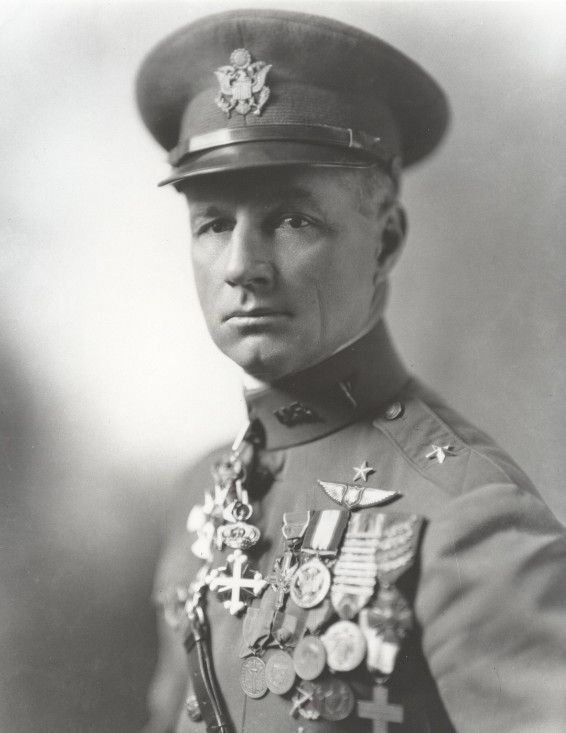 William Lendrum “Billy” Mitchell was born on December 29, 1879, in Nice, France, to American parents and spent his childhood in Wisconsin, where he grew up bilingual and steeped in public‑service expectations set by his father, U.S. Senator John L. Mitchell, and his prominent Milwaukee family.
At the outbreak of the Spanish American War in 1898, Mitchell enlisted rather than rely on family privilege, the first sign of a career‑long pattern of choosing action over comfort. He received early assignments in Cuba and the Philippines, and soon demonstrated a rare mix of field grit and technical aptitude. After accepting a Regular Army commission in the Signal Corps, he led rugged expeditions across the Alaskan interior to scout and help build military telegraph lines—work that forged his reputation for operational toughness in extreme conditions.
By the 1910s, Mitchell was among the Army’s most promising young staff officers. Drawn to the new frontier of military aviation, he transferred into the Signal Corps’ aviation section. When the Army judged him “too old” to train as a pilot at 38, he quietly paid for civilian flying lessons and earned his wings anyway—an early indicator of the stubborn independence that would define his advocacy for airpower.
Mitchell arrived in Europe before America formally entered World War I, studying aircraft production and tactics. Once the U.S. committed forces, he advanced rapidly, ultimately commanding all American air combat units in France. In September 1918, during the St. Mihiel offensive, he orchestrated what was then the largest Allied air operation of the war—nearly 1,500 aircraft—demonstrating massed airpower’s ability to shape ground outcomes and foreshadowing how air superiority would dominate future conflicts.
The war’s end elevated Mitchell to national prominence, and he used that platform to press a controversial thesis: aircraft had rendered the battleship obsolete, and the United States needed a separate, well‑funded air arm. To prove his point, he organized a series of headline‑grabbing demonstrations in 1921–1923 against surplus and captured warships, culminating in the sinking of the German dreadnought Ostfriesland under concentrated aerial bombing—spectacle and evidence in one stroke.
Mitchell’s public campaign, however, grew sharper as he collided with institutional resistance. In 1925, after a series of aviation disasters, he accused Army and Navy leaders of “criminal negligence” and an “almost treasonable” approach to national defense. The military establishment responded with a court‑martial for insubordination; Mitchell was found guilty and suspended from active duty. He resigned in early 1926, but the drama transformed him into a cause célèbre—and his broader warnings, including the vulnerability of Pearl Harbor to a surprise Japanese air attack, would echo ominously in the decades ahead.
Away from uniform, Mitchell wrote, lectured, and doubled down on his vision of a future in which airpower decided wars through strategic bombing, fast‑rising fighter technology, and global reach. Though he died in 1936, history soon vindicated his core ideas: World War II saw aircraft sink capital ships, strategic air campaigns reshape battlefields and economies, and the United States eventually establish an independent Air Force. Posthumous honors followed, including the Congressional Gold Medal, the naming of the B‑25 Mitchell bomber in his honor, and the renaming of Milwaukee’s airport as Mitchell International—a hometown acknowledgment that the local senator’s son had, in fact, seen the future.